
From the 30-share blue-chip pack, Adani Ports, UltraTech Cement, Larsen & Toubro, Sun Pharma, HDFC Bank, ICICI Bank, NTPC and State Bank of India were the major laggards. Tata Consultancy Services, Reliance Industries, ITC, Asian Paints, HCL Tech and Maruti were among the gainers.
From the 30-share blue-chip pack, Adani Ports dropped over 4 per cent. UltraTech Cement, Sun Pharma, IndusInd Bank, NTPC and Tata Steel were also the among the laggards. Nestle, ICICI Bank, Infosys, Tata Consultancy Services and HCL Tech were among the gainers.

Reliance Industries Ltd (RIL) on Friday reported a 9.6 per cent year-on-year rise in net profit for the September quarter, driven by strong performance in its consumer-facing retail and telecom businesses and a recovery in its core oil-to-chemicals segment.

'The Pahalgam terror attacks and the conflict that followed were a big blow to local tourism.' 'And just when things were starting to go back to normal, the floods, caused by heavy rain, spoiled all chances of a bounce-back this season.'

Global fund managers witnessed one of their largest-ever declines in assets under custody (AUC) during the ongoing correction in the Indian markets, as stocks came under pressure from foreign outflows and the weakening rupee.

Given the stronger rural activity, and potential goods and services tax (GST) impact, investors are bullish on the two-wheeler (2W) segment. In August, dealers in the domestic market picked up 11 per cent more 2Ws year-on-year (Y-o-Y), despite only 2 per cent growth in retail registrations. This indicates inventory stocking ahead of the festival season. Export trends were good. TVS Motor and Royal Enfield may have gained domestic market share.
'Raising the entire amount in one go may not be prudent, given the market dynamics.'

Equity benchmark indices Sensex and Nifty rebounded sharply on Monday after five days of steep decline amid value buying at lower levels and a rally in global markets. Besides, hectic buying in blue-chip stocks ITC, HDFC Bank and Reliance Industries also helped in market recovery.

India's goods exports rebounded in July after two months of contraction, with outbound shipments rising 7.3 per cent to $37.24 billion, led by a surge in exports to the United States before the country's reciprocal tariff kicked in and bolstered by a recovery in exports to other key markets.
Investors need to carefully assess country-specific risks. 'This is especially true of a market that is less transparent than the US.'

On the other hand, Bharat Electronics, Kotak Mahindra Bank and Axis Bank were the laggards. In Asian markets, South Korea's Kospi, Japan's Nikkei 225 index, Shanghai's SSE Composite index and Hong Kong's Hang Seng settled higher.
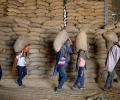
Truck movements across the India-Bangladesh border are on the rise, with increasing rentals signalling a trade recovery between the two South Asian nations. Yet, geopolitical tension looms large, with Bangladesh now under an interim government for nearly two months.
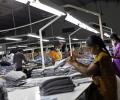
In the shadows of a sliding rupee, India's knitwear hub Tiruppur is weaving a success story. While the domestic currency edges closer to the 86 mark against the US dollar, triggering concerns for many sectors, this textile town in Tamil Nadu is finding opportunity in adversity: Between April and December alone, Tiruppur's exports reached Rs 26,000 crore, almost eclipsing last financial year's total of Rs 30,690 crore.

Fast-moving consumer goods (FMCG) companies, retail firms, and producers of consumer durables are witnessing stable urban demand. However, people in the trade are waiting for clearer signs of revival closer to the festival season, starting in September.

Small and midcaps are leading the charge in the latest market rebound. Since November 21, when the benchmark S&P BSE Sensex and the National Stock Exchange Nifty hit their recent lows and slipped into correction territory, the Nifty Smallcap 100 index has risen by 8 per cent, while the Nifty Midcap 100 has gained 5.7 per cent. Meanwhile, the Nifty 50 index has risen by 4.7 per cent during this period.

'Listing of scaled Indian subsidiaries of multinational corporations as well as of Indian conglomerates continues to remain a key theme for IPOs in India.'

GST 2.0 may cushion consumers against US tariffs, but like the 2019 corporate tax cut, it risks being another tactical fix rather than a structural growth strategy, expects Debashis Basu.

Real wealth isn't built on random bets; it's built on disciplined, guided portfolio strategies that can withstand market ups and downs, says Ramalingam Kalirajan.

The statement did not name any country. But the US has often blamed India and China for purchasing Russian oil even when there are no tariffs on Beijing for it.

India is among the three least-favoured Asian stock markets, according to BofA Securities whose survey found that 10 per cent of fund managers are underweight on Indian equities from a 12-month perspective.

'2025 is the year to build a portfolio for the future. Focus this year should be on valuations and visible growth.'

Life Insurance Corporation of India's (LIC) annualised premium equivalent (APE) growth remained weak in the fourth quarter of the financial year 2024-25 (Q4FY25) and flat in FY25, but management expects growth to rebound in FY26. The focus remains on improving product mix by increasing share of non-participating or non-par products in the individual APE.

Analysts are warning of growing risks to the market's sustained momentum, and even to the possibility of consolidation at current levels. Domestically, markets are grappling with several challenges, including a slowing economy, as indicated by the latest GDP data for the July-September (Q2) quarter of 2024-25 (FY25), sticky inflation, fluctuations in the rupee, waning consumption, and high interest rates.

Investors became richer by nearly Rs 8 lakh crore on Wednesday as benchmark BSE Sensex surged by 740 points amid value buying in utilities and power shares and a strong trend in global markets. The 30-share BSE Sensex surged by 740.30 points or 1.01 per cent to close at 73,730.23.

Benchmark stock indices Sensex and Nifty closed higher for a second straight session on Monday following buying in index majors Reliance Industries, ICICI Bank and recovery in global markets.

Why try to time the market when time in the market works better? History shows that patient investors who stay the course often walk away with the real rewards, says Ramalingam Kalirajan.

From the Sensex firms, HCL Tech, Tata Steel, Tech Mahindra, Reliance Industries, Bharat Electronics and ICICI Bank were among the laggards. Bajaj Finance, Hindustan Unilever, UltraTech Cement and Power Grid were among the gainers.

The multi-agency search operation to trace 33 missing persons in cloudburst-hit Kishtwar district in Jammu and Kashmir has entered its eighth day. The death toll stands at 65, and rescue efforts are ongoing with the help of multiple agencies and heavy machinery.

The domestic stock market will continue to monitor the Israel-Iran conflict and its impact on global supplies besides prices of crude oil this week, analysts said. Global trends and trading activity of foreign investors would also drive investors' sentiment during the week.

Indian IT hiring landscape is at a pivotal juncture as it transitions from a year of decline towards a more hopeful future. The focus on specialised skills, particularly in AI and data science, combined with geographical shifts towards Tier 2 cities, indicates a transformation within the sector.

Bajaj Auto - the country's most valuable two-wheeler (2W) company by market capitalisation - met Street expectations in the January-March quarter (Q4) of 2024-25 (FY25) but still ended Friday as the worst performer on the Nifty 50, slipping 3.1 per cent.

Marico's January-March quarter (Q4) results were slightly better than consensus. Revenue was up by 1.7 per cent year-on-year (Y-o-Y) to Rs 2,280 crore. Ebitda grew by 12.5 per cent Y-o-Y to Rs 440 crore. Adjusted PAT was up 10.3 per cent Y-o-Y to Rs 320 crore.

Trends in the global energy markets are crucial if India's growth outlook is to remain healthy. Prices for the Indian crude basket were averaging around $86.2 per barrel through Q1FY25 and then moderated to $84 in July and to $78-79 in August (so far). But global crude supply may outpace weak global demand in the short term.

India, the world's third largest oil importing and consuming nation, is likely to save as much as Rs 1.8 lakh crore on import of crude oil and LNG if the trend of softening international energy rates continues, Icra said Wednesday. India, which meets over 85 per cent of its crude oil needs through imports, spent $242.4 billion on buying crude from overseas in the fiscal year ended March 31, 2025.

Stopping SIPs during a downturn undermines the benefit of rupee-cost averaging.

Investors' wealth climbed Rs 3.20 lakh crore as markets staged a smart comeback on Wednesday after falling in the last eight trading sessions. The BSE Sensex rallied 448.96 points or 0.76 per cent to settle at 59,411.08. During the day, it jumped 513.33 points or 0.87 per cent to 59,475.45.

From the 30 Sensex firms, Mahindra & Mahindra, Bajaj Finance, Asian Paints, Nestle, Bharti Airtel, UltraTech Cement, Hindustan Unilever, ITC, and HDFC Bank were the major laggards. In contrast, Infosys, Tech Mahindra, Tata Motors, Axis Bank, Tata Consultancy Services and State Bank of India were among the gainers.

'Of the 20 trading days of January till January 28, FIIs have been selling for 19 trading days'. 'When did FIIs withdraw money with this kind of intensity?' 'It never happened. It's the first. It did not happen even during the 2008-2009 financial crisis when Lehman went under.' 'Even then you did not have like a 19-day selling spree from the FIIs.'

'As the markets are expected to remain jittery in the near term, we advise investors to use this opportunity to enter quality largecaps from a long-term perspective.'

'Indian equity valuations, although not very expensive, are not cheap either.'
